Fort Campbell - Selmun, Malta - Abandoned Coastal Fortress Seen from Mistra Bay
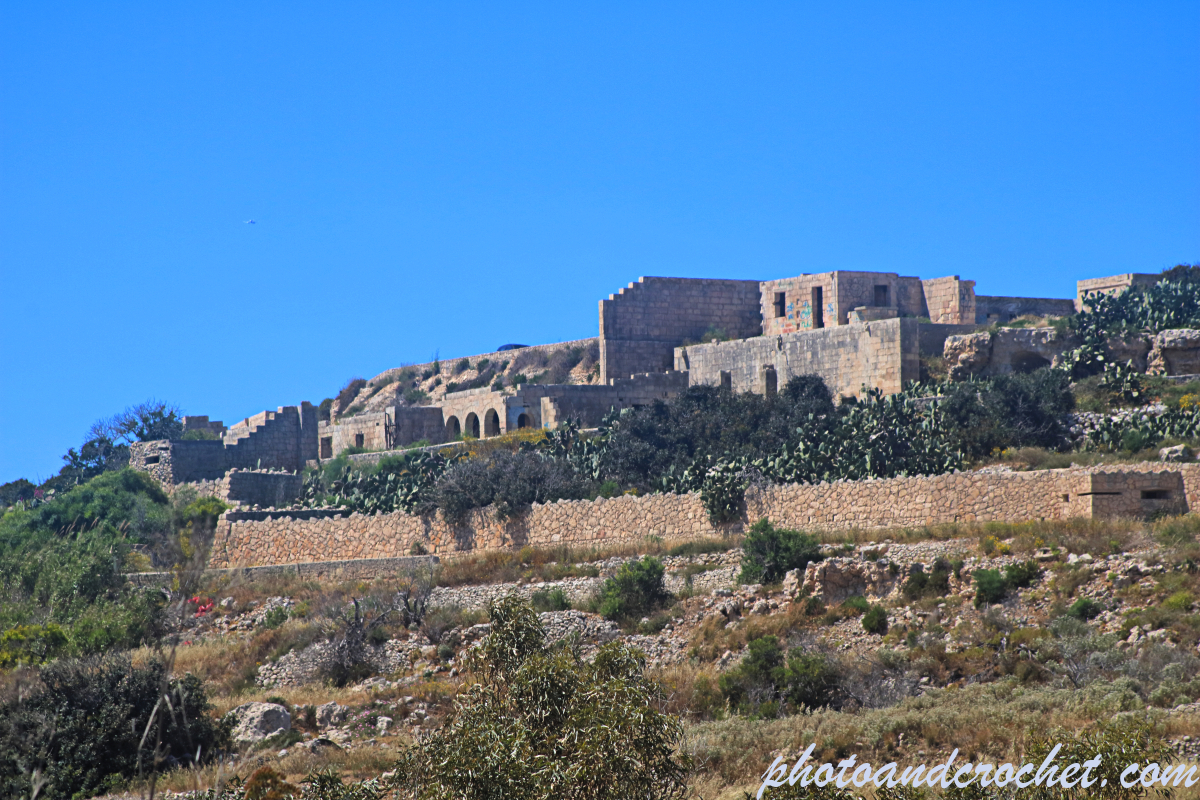
A view of Fort Campbell from Mistra Bay in northern Malta, showing the abandoned British military buildings, arched limestone structures and terraced defensive walls rising above the Mediterranean countryside.
This photograph shows Fort Campbell from the direction of Mistra Bay, looking towards the abandoned military complex on the hillside of the Selmun peninsula in northern Malta. The fort’s surviving limestone buildings extend across the upper slopes, with several substantial rectangular structures rising above a series of lower walls and terraces. A distinctive row of stone arches is visible near the centre of the complex, while the surrounding buildings appear partially concealed by the irregular terrain. In the foreground, traditional limestone retaining walls divide the rocky hillside into terraces covered with Mediterranean scrub, prickly pear cacti, grasses and scattered shrubs. The warm colour of the stone contrasts with the brilliant blue sky, creating an impression of an old rural settlement rather than a former coastal artillery fortress.
Fort Campbell was constructed by the British between 1937 and 1938 as part of Malta’s coastal defence system shortly before the Second World War. Located on the Selmun peninsula between Mistra Bay and the northern approaches to St Paul’s Bay, the fort occupied a strategically important position overlooking the surrounding Mediterranean waters. Its principal armament consisted of three 6-inch coastal artillery guns intended to defend the maritime approaches against potentially hostile vessels. Unlike the imposing bastioned fortifications built during earlier centuries, Fort Campbell was designed to remain relatively inconspicuous within the landscape. Its perimeter followed an irregular course, while low walls, dispersed military buildings and the surrounding agricultural terraces helped disguise the installation from aerial observation. This approach reflected the growing importance of camouflage and concealment in twentieth-century military engineering. The complex incorporated gun emplacements, observation and fire-control facilities, accommodation buildings and other structures required for the operation of a coastal artillery battery. The view from Mistra Bay provides a particularly useful perspective on the overall arrangement of the fort, showing how its buildings were distributed across the hillside rather than concentrated behind monumental defensive walls. Following the end of its military service, Fort Campbell was abandoned, and many of its buildings deteriorated through weathering, damage and the removal of reusable materials. Today, its surviving limestone structures remain an important reminder of Malta’s British military heritage. This photograph documents the fort from below, highlighting the unusual relationship between its military architecture and the traditional terraced landscape of the Selmun peninsula.
You have to be logged in to leave a comment
Comments
No comments yet.
Fort Campbell - Selmun, Malta - Abandoned Coastal Fortress Seen from Mistra Bay
by Dieter
Uploaded on April 30, 2023
Prev |
| Camera: | Canon |
| Model: | Canon EOS 2000D |
| Creation Date: | 2023:04:30 19:15:43 |
| Image width: | 6000 px |
| Image height: | 4000 px |
| Image size: | 26MB |
| Aperature: | f/11.0 |
| Exposure: | 1/200 |
| ISO - speed: | 100 |
License for images free to download:
Creative Commons CC BY-NC-ND 4.0
Please give the image a rating.
The average rating is 3.00.