Chapel of St Anne - Fort St Angelo, Birgu - Historic Limestone Façade and Bell-Cot
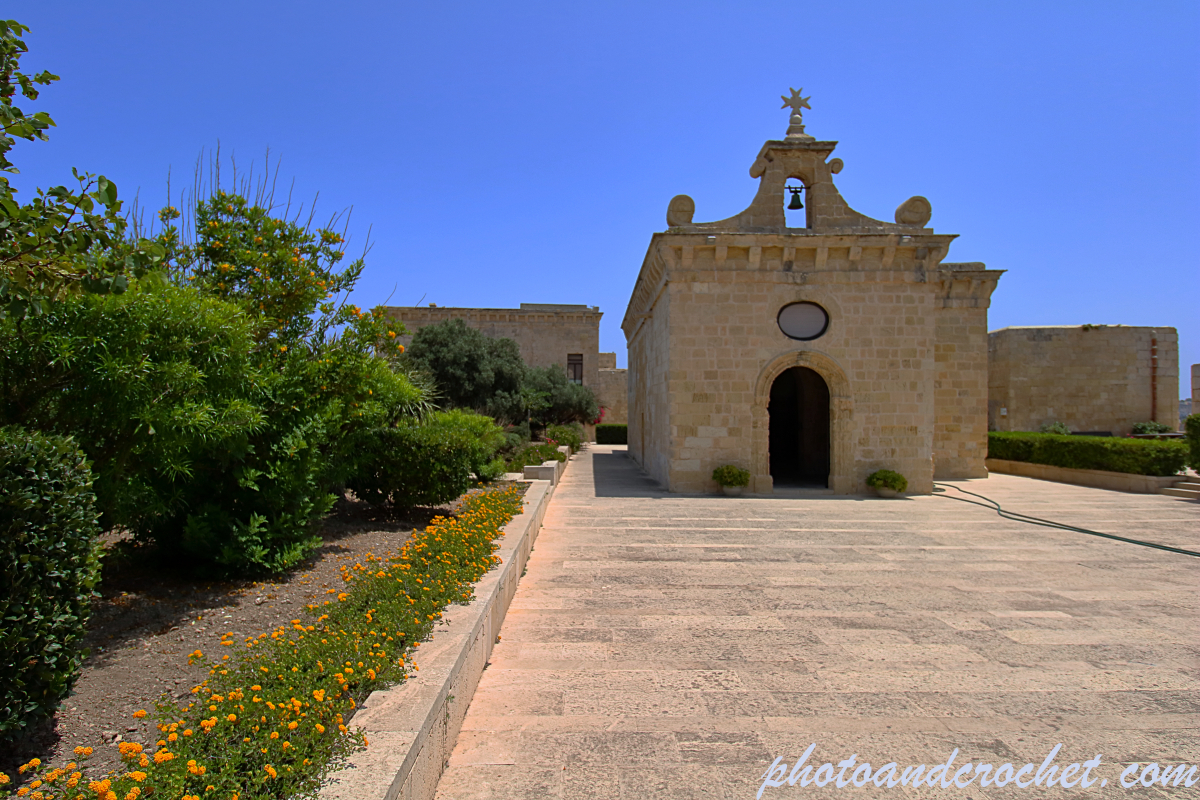
The historic Chapel of St Anne in the upper section of Fort St Angelo, Birgu, Malta, featuring a traditional limestone façade, arched entrance and decorative bell-cot overlooking a peaceful courtyard.
This photograph shows the historic Chapel of St Anne, situated within the upper section of Fort St Angelo in Birgu, Malta. The small limestone chapel stands at the end of a spacious paved courtyard, surrounded by the substantial defensive structures of the fortress. Its simple rectangular façade features a tall rounded entrance arch, a circular feature above the doorway and an elegant decorative bell-cot rising above the roofline. A small bell hangs beneath the curved stonework, while a cross crowns the uppermost section. Rounded stone ornaments and carefully shaped architectural details provide an attractive contrast to the otherwise restrained exterior. On the left, a landscaped garden with mature shrubs, small trees and bright orange flowers adds colour to the historic surroundings. The warm golden limestone and clear blue Mediterranean sky create a peaceful atmosphere, emphasizing the chapel’s distinctive position within one of Malta’s most important military landmarks.
The Chapel of St Anne is among the oldest surviving religious structures associated with Fort St Angelo and has its origins in the medieval history of the fortress. Before the arrival of the Knights of St John in Malta in 1530, the site was occupied by a fortified castle known as the Castrum Maris, which guarded the strategically important entrance to Grand Harbour. The chapel served the religious needs of the castle’s occupants and became closely associated with the long military and maritime history of the site. When the Knights established their headquarters in Birgu, Fort St Angelo became their principal stronghold and the residence of the Order’s Grand Master. The chapel continued to form part of the fortress complex, providing a place of worship within an environment otherwise dominated by military and defensive functions. During the Great Siege of Malta in 1565, Fort St Angelo played a decisive role in defending Birgu against the Ottoman forces, and its religious buildings formed part of the daily spiritual life of those stationed within the fortifications. Over subsequent centuries, the fortress underwent numerous alterations as successive military authorities adapted its buildings and defensive structures to changing requirements. During British rule, Fort St Angelo became an important Royal Navy establishment and was eventually commissioned as HMS St Angelo. Despite these changes, the Chapel of St Anne remained an important reminder of the site’s earlier religious heritage. Conservation and restoration work has helped preserve the chapel and its surrounding historic structures for future generations. Today, visitors exploring the upper sections of Fort St Angelo can discover this small but historically significant place of worship, which provides a fascinating contrast to the surrounding military architecture. This photograph highlights the chapel’s attractive limestone façade and peaceful courtyard setting, illustrating how religious and military history have remained closely connected within the fortress for centuries.
You have to be logged in to leave a comment
Comments
No comments yet.
Chapel of St Anne - Fort St Angelo, Birgu - Historic Limestone Façade and Bell-Cot
by Dieter
Uploaded on July 2, 2023
Prev | Next |
| Camera: | Canon |
| Model: | Canon EOS 2000D |
| Creation Date: | 2023:07:02 11:43:07 |
| Image width: | 6000 px |
| Image height: | 4000 px |
| Image size: | 23.8MB |
| Aperature: | f/5.0 |
| Exposure: | 1/1250 |
| ISO - speed: | 100 |
License for images free to download:
Creative Commons CC BY-NC-ND 4.0
Please give the image a rating.
The average rating is 2.99.