Flying Gurnard - Dactylopterus volitans - Spotted Pectoral Fin Above the Sandy Seabed
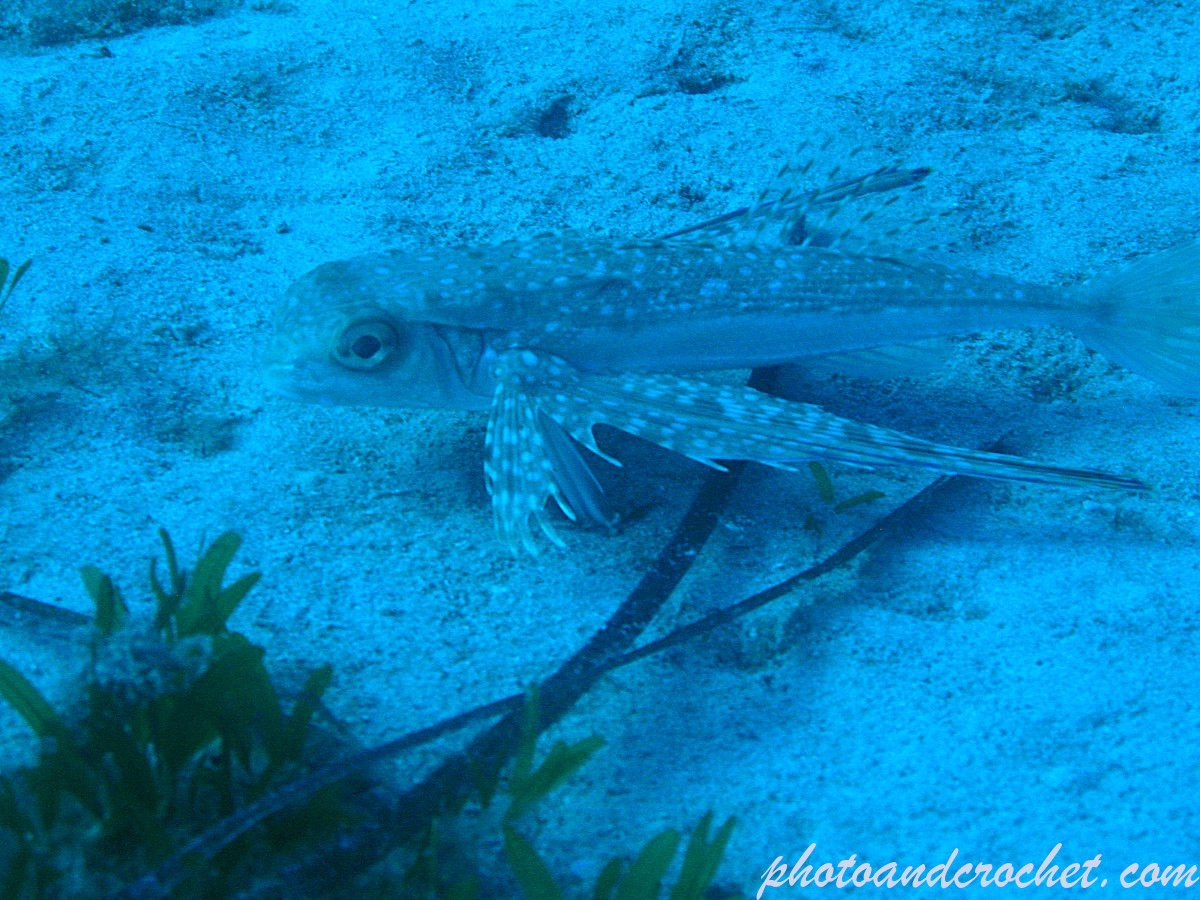
A Flying Gurnard (Dactylopterus volitans) photographed from the side at Ċirkewwa Marine Park, Malta, displaying its large eye, raised dorsal spines and beautifully spotted, partially extended pectoral fin.
This underwater photograph captures a Flying Gurnard (Dactylopterus volitans) resting or moving slowly above the sandy seabed at Ċirkewwa Marine Park, Malta. Viewed from the side, the fish reveals its elongated body, large rounded eye and heavily armoured head, together with the distinctive spines extending along its dorsal surface. One of its broad, wing-like pectoral fins is partially extended, displaying an intricate pattern of pale blue spots, darker markings and elongated fin rays. The fish is positioned above a lightly textured sandy bottom, with scattered patches of seagrass and marine vegetation visible in the foreground. The predominantly blue underwater lighting gives the scene a cool appearance while emphasizing the remarkable structure of the fish and its unusually large fins.
The Flying Gurnard belongs to the family Dactylopteridae and is one of the most distinctive bottom-dwelling fishes encountered in the Mediterranean Sea. Despite its common name, it is not capable of flying or gliding through the air. Its most remarkable feature is the pair of greatly enlarged pectoral fins, which can be spread into broad, colourful displays resembling wings. These fins are thought to help discourage predators by making the fish appear considerably larger and more intimidating. When folded against the body, their intricate patterns are much less conspicuous. The species has a robust, bony head, prominent eyes and a body protected by relatively hard scales. Smaller forward sections of the pectoral fins assist with movement and exploration along the seabed. Flying Gurnards inhabit sandy and muddy bottoms, often near rocky areas and seagrass meadows, where they search for small crustaceans, molluscs and other bottom-dwelling invertebrates. The species occurs throughout the Mediterranean and in parts of the Atlantic Ocean. This photograph highlights the unusual anatomy of the Flying Gurnard, particularly its spotted pectoral fin, raised dorsal spines and characteristic bottom-dwelling behaviour in the waters surrounding Malta.
You have to be logged in to leave a comment
Comments
No comments yet.
Flying Gurnard - Dactylopterus volitans - Spotted Pectoral Fin Above the Sandy Seabed
by Dieter
Uploaded on October 16, 2026
Prev |
| Camera: | Canon |
| Model: | Canon PowerShot G9 |
| Creation Date: | 2026:10:15 11:37:57 |
| Image width: | 4000 px |
| Image height: | 3000 px |
| Image size: | 17.72MB |
| Aperature: | f/4.5 |
| Exposure: | 1/125 |
| ISO - speed: | 320 |
License for images free to download:
Creative Commons CC BY-NC-ND 4.0
Please give the image a rating.
Be the first to rate this image.