Fort St Angelo - Birgu, Malta - Historic Cannons on the Harbour Defence Battery
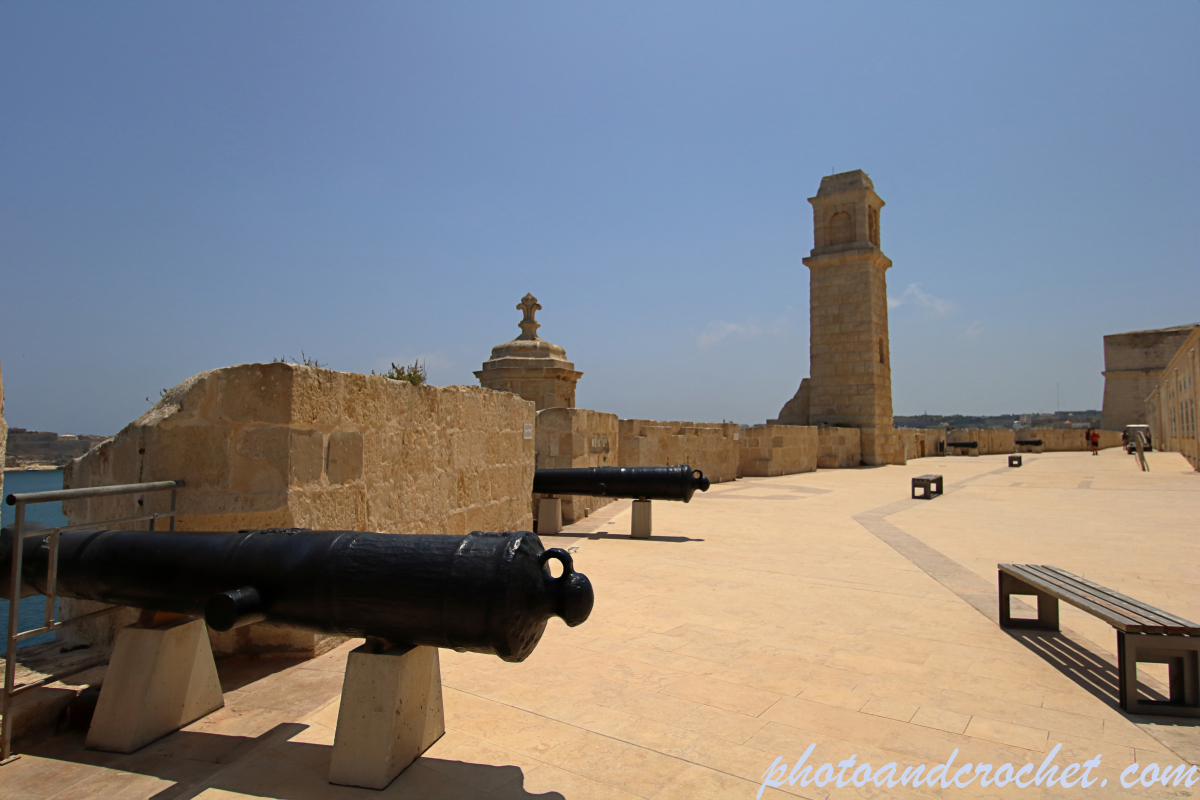
Historic muzzle-loading cannons displayed on the limestone artillery terrace at Fort St Angelo in Birgu, Malta, with defensive parapets, a stone cross and a tall masonry tower overlooking the approaches to Grand Harbour.
This photograph shows part of the historic artillery battery at Fort St Angelo in Birgu, Malta, where two black iron cannons are displayed along a broad limestone terrace. The nearest cannon dominates the foreground, its heavy barrel resting on pale stone supports beside a low defensive wall. A second cannon stands farther along the terrace, pointing towards the harbour approaches that the fortress was originally designed to protect. The open space is paved with light-coloured stone, reflecting the strong Mediterranean sunlight. A decorative stone cross rises above one section of the parapet, while a tall rectangular masonry tower stands prominently against the clear blue sky. Several simple benches are positioned along the terrace, providing visitors with places to rest while exploring the historic fortifications. The combination of artillery, traditional limestone architecture and open defensive platforms illustrates the military character of one of Malta’s most important historic fortresses.
Fort St Angelo occupies a commanding position at the tip of the Birgu peninsula, overlooking the entrance to Malta’s strategically important Grand Harbour. Its origins can be traced to the medieval period, when a fortified castle known as the Castrum Maris protected the harbour and surrounding settlements. After the Knights of St John arrived in Malta in 1530, the fortress became their principal military stronghold and underwent extensive improvements to strengthen its defensive capabilities. During the Great Siege of 1565, Fort St Angelo played a decisive role in resisting the Ottoman assault on Birgu and the surrounding harbour fortifications. Over the following centuries, the fortress was repeatedly modified to accommodate developments in artillery and military engineering. Gun batteries positioned along its walls and bastions were intended to control maritime approaches, protect shipping and support the defence of the harbour. Cannons such as those displayed in this photograph recall the period when muzzle-loading artillery formed an essential part of coastal fortifications throughout the Mediterranean. During British rule, Fort St Angelo continued to serve military purposes and eventually became an important Royal Navy establishment known as HMS St Angelo. Following the end of its active military role, restoration and conservation projects helped preserve the historic complex for future generations. Today, visitors can explore its defensive terraces, batteries, historic buildings and panoramic viewpoints while discovering the fortress’s long association with Malta’s military and maritime history. This photograph captures the atmosphere of the restored artillery terrace, where historic cannons remain as reminders of the fortress’s original purpose: protecting one of the Mediterranean’s most strategically important natural harbours.
You have to be logged in to leave a comment
Comments
No comments yet.
Fort St Angelo - Birgu, Malta - Historic Cannons on the Harbour Defence Battery
by Dieter
Uploaded on July 1, 2023
Prev | Next |
| Camera: | Canon |
| Model: | Canon EOS 2000D |
| Creation Date: | 2023:07:01 21:20:14 |
| Image width: | 6000 px |
| Image height: | 4000 px |
| Image size: | 11.31MB |
| Aperature: | f/5.0 |
| Exposure: | 1/2500 |
| ISO - speed: | 100 |
License for images free to download:
Creative Commons CC BY-NC-ND 4.0
Please give the image a rating.
The average rating is 3.00.