Rainbow Wrasse - Coris julis - Female Colouration Above the Rocky Seabed
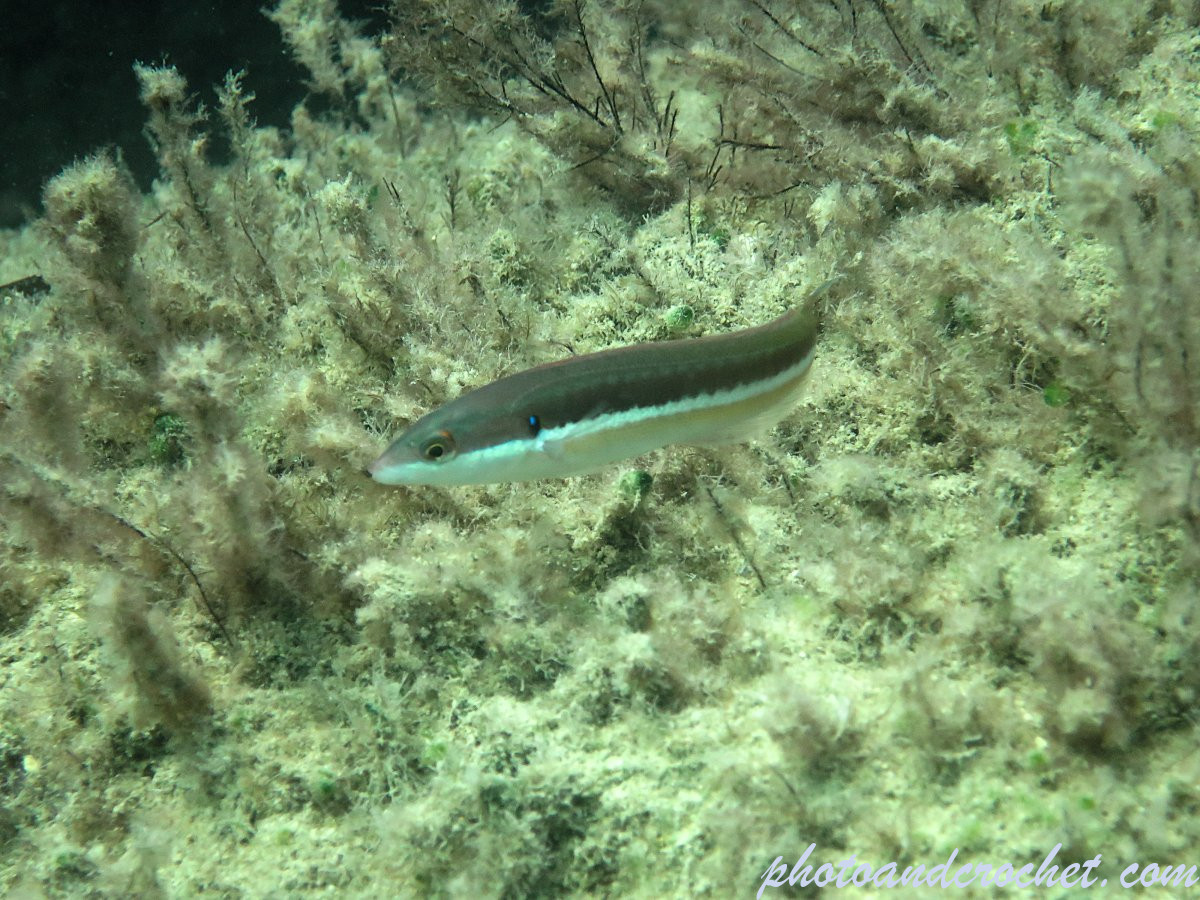
A Mediterranean Rainbow Wrasse (Coris julis) displaying its characteristic female or initial-phase colouration while swimming above an algae-covered rocky seabed at Slugs Bay, Malta.
This underwater photograph captures a Mediterranean Rainbow Wrasse (Coris julis) swimming just above an algae-covered rocky seabed at Slugs Bay, on the northern coast of Malta. The fish is photographed in profile, clearly displaying its slender, elongated body, pointed snout and distinctive horizontal colour pattern. Its upper body is dark brownish-green, separated from the pale underside by a prominent, slightly irregular white stripe extending along the sides towards the tail. A small dark marking near the pectoral fin and the subtle reddish colouration around the eye provide additional identifying features. The fish is surrounded by dense patches of marine algae growing across the uneven rocky surface, creating a natural background that closely resembles its preferred habitat. The soft underwater lighting reveals the contrast between the darker upper body and the lighter lower half, while the fish appears to be moving calmly through the vegetation. Its colouration is characteristic of the female or initial phase of the species, which differs considerably from the more brightly coloured adult males.
The Mediterranean Rainbow Wrasse, scientifically known as Coris julis, belongs to the family Labridae and is a common inhabitant of coastal waters throughout the Mediterranean Sea and parts of the eastern Atlantic Ocean. This small, active fish is frequently encountered by snorkellers and scuba divers around rocky reefs, algae-covered seabeds and the edges of seagrass meadows, including areas containing Neptune grass (Posidonia oceanica). Rainbow Wrasses are usually found in relatively shallow coastal waters but have also been recorded at considerably greater depths. They generally reach lengths of around 20 centimetres, although larger individuals approaching 25 centimetres have been reported. One of the most fascinating characteristics of this species is its pronounced sexual colour variation. Females and initial-phase individuals typically have brownish or reddish upper bodies with a pale lateral stripe, whereas terminal-phase males display much brighter greenish-blue, orange and reddish markings. The species is a protogynous hermaphrodite, meaning that individuals generally develop first as females, with some later changing sex and becoming males. This transformation involves changes in reproductive function, behaviour and external colouration. Rainbow Wrasses feed mainly on small benthic invertebrates, including crustaceans, molluscs and other organisms found among rocks and marine vegetation. They are active during daylight hours and commonly seek shelter by burying themselves in sand at night. Their constant movement and contrasting colour patterns make them particularly interesting subjects for underwater photography. This photograph documents the more subtly coloured initial phase of the Rainbow Wrasse in its natural Mediterranean habitat, illustrating the rich marine biodiversity found around Malta’s rocky coastline.
You have to be logged in to leave a comment
Comments
No comments yet.
Rainbow Wrasse - Coris julis - Female Colouration Above the Rocky Seabed
by Dieter
Uploaded on October 23, 2026
Prev |
| Camera: | Canon |
| Model: | Canon PowerShot S120 |
| Creation Date: | 2026:10:23 11:24:11 |
| Image width: | 4000 px |
| Image height: | 3000 px |
| Image size: | 12.61MB |
| Aperature: | f/4.5 |
| Exposure: | 1/500 |
| ISO - speed: | 800 |
License for images free to download:
Creative Commons CC BY-NC-ND 4.0
Please give the image a rating.
Be the first to rate this image.